
Architecture
Technical overview of IRFlow Timeline's architecture for developers and contributors.
v1.0.6+ modular layout (current: v1.0.13). What was once a ~20K-line
App.jsxand monolithicelectron/parser.js/electron/db.jsis now decomposed into focused modules across the renderer and main process (parsers/,ipc/,jobs/,analyzers/, and related trees). v1.0.8 extended the AI parser subsystem, triage collection orchestration, worker lifecycle controls, and multi-source analyzers; v1.0.9 added bounded native EVTX chunk ingestion; v1.0.10 added ChatGPT Computer History (Skysight) plus crash-safe session recovery and a global worker budget; v1.0.11 verified Computer History against a live capture; v1.0.12 added tab diffing and version-aware Hayabusa command construction; and v1.0.13 adds read-only VHDX/NTFS triage extraction, versioned AI source coverage and acquisition metrics, plus Process Inspector and Lateral Movement correctness hardening. The file references below reflect that layout.
System Architecture
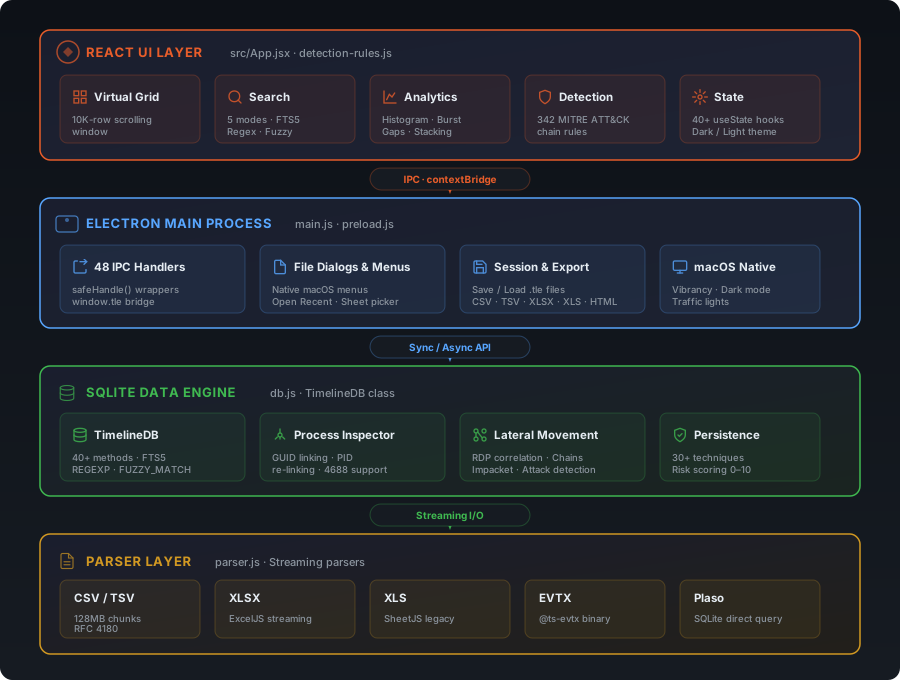
The diagram uses a semantic color system — color maps to function, not just layer:
| Color | Meaning |
|---|---|
| 🟠 Orange | UI / output surface |
| 🟣 Violet | Secure IPC bridge |
| 🔵 Blue | Orchestration & network |
| 🟡 Amber | Ingestion & compute |
| 🟢 Green | Data & persistence |
| 🔴 Red | Forensic detection |
Layer Responsibilities
Renderer Process (React)
Entry: src/main.jsx (~60 lines) → Coordinator: src/App.jsx (~3,800 lines)
The renderer runs in a sandboxed browser context with no direct Node.js access — all system operations go through the IPC bridge. App.jsx is now a thin top-level coordinator; responsibility is distributed across focused trees:
components/—VirtualGrid,MenuBar,FilterBar,TabBar,StatusBar,SelectionBar;primitives/(Modal, Button, Toast, ConfirmDialog, …);modals/(one file per analysis modal — Sigma, Lateral Movement, Persistence, Ransomware, USN, ADS, Timestomping, RDP bitmap cache, Triage Collection, …);process-analyzer/(Process Inspector UI: orchestrator modal + config / loading / results / graph / verdict hero / rule health phases)store/— Zustand stores:useTabStore,useUIStore,useGridInteractionStore,useConfirmStore,useToastStorehooks/,modals/modalRegistry.js(namespaced modal state),constants/(themes.js,presets.js,kape-profiles.js, …),utils/(ipc-result.js,datetime.js,process-inspector/process-inspector-pipeline/process-rule-health/process-grid-pivot/process-handoffs, a mirror offorensic-normalize, …)detection-rules.js+detection-rules/(tool-aliases.js— the canonical RMM/tunnel/exfil tool catalog), mapped to MITRE ATT&CK and consumed by the process analyzer
Responsibilities: grid rendering with virtual scrolling, user-interaction handling, Zustand state management, visualization (histogram, process inspector, lateral-movement graphs, NTFS analysis panels), KAPE profile auto-detection, VirusTotal verdict display, and theme management (dark default + light).
Preload Bridge
File: electron/preload.js (~240 lines)
The preload script creates a secure bridge between renderer and main using Electron's contextBridge. It exposes a whitelisted window.tle API with contextIsolation enabled and nodeIntegration disabled. All renderer↔main calls go through here as invoke-only channels; listener registrations return unsubscribe functions. Channels cover file ops, queries, tag/bookmark ops, IOC/VirusTotal enrichment, analysis (NTFS, lateral movement, Sigma, RDP bitmap cache), jobs, session persistence, filter presets, and auto-update.
v1.0.8 AI Artifacts / Secret Hunt surface (same invoke-only pattern):
window.tle method | IPC channel | Purpose |
|---|---|---|
discoverAiHistoryProfile | discover-ai-history-profile | Profile scan before Collect AI Artifacts |
extractAiHistoryProfile | extract-ai-history-profile | Merged multi-app extract into one tab |
cancelAiHistoryExtract | cancel-ai-history-extract | Cancel in-flight profile extract |
decodeAiHistory | decode-ai-history | Per-app folder/file import (AI Apps menu) |
decodeComputerHistory | decode-computer-history | ChatGPT Computer History (Skysight) extract — own 54-column tab |
pickAiHistoryScanFolder | pick-ai-history-scan-folder | Browse-folder target picker |
analyzeAiHistory | analyze-ai-history | AI Secret Hunt over an AI Query History tab |
exportAiHistoryPackage | export-ai-history-package | Forensic export package + source manifest |
exportAiSecretsPdf | export-ai-secrets-pdf | Secret Hunt results PDF |
openAiSource | open-ai-source | Jump to source file/line from a grid row |
Progress for profile extract streams on ai-history-profile-progress.
Main Process (Electron)
Files: main.js (~520 lines) · import.js (~240) · menu.js (~290) · updater.js (~545) · logger.js (~50) · ipc/ (14 modules)
The main process runs with full Node.js access and acts as the orchestrator:
main.js— creates and owns theBrowserWindow, defines thesafeHandle/safeSendIPC primitives, owns the serialized import queue and the deferred index/FTS build queue, and delegates IPC registration toipc/index.js, menus tomenu.js, and updates toupdater.js. On macOS, close hides the live window and Dock activation restores it. Fatal main/renderer failures synchronously close workers and databases, flush diagnostics, and relaunch once behind a crash-loop guard. Raises the V8 heap to 16 GB for large imports.import.js— import pipeline: validation, XLSX sheet selection, large-file warnings, USN↔MFT path resolution, and index scheduling.ipc/— one registration module per domain (query-,tag-,analysis-,export-,session-,vt-,sigma-,job-,rdp-bitmap-cache-,triage-handlers, and release-specific modules such as AI history when enabled), all registered byipc/index.js. Each handler is wrapped bysafeHandle().updater.js— auto-update lifecycle (check → download → install) viaelectron-updater.logger.js— shared singleton debug logger (electron/logger.js) with ~5 MB rotation and a write buffer (~/tle-debug.log);dbg(scope, message, data?)is used across main-process modules (not the legacy monolithicparser.js/db.jspaths).
safeHandle/safeSend wrap every handler to log and catch errors; on failure they return { __ipcError: true, message }, which the renderer must check via isIpcError() — a resolved value is not necessarily success.
Worker Threads
Files: electron/jobs/job-manager.js + import-worker.js · index-worker.js · query-worker.js · analyzer-worker.js · sigma-worker.js · ai-history-profile-worker.js · computer-history-worker.js · triage-discover-worker.js · vhdx-extract-worker.js
CPU-heavy work runs off the main thread in worker_threads, coordinated by job-manager.js:
import-worker— streams a source file throughparsers/index.jsinto a temp SQLite DB (single AI app folders viaparsers/ai-history/decode path)ai-history-profile-worker— Collect AI Artifacts merged extract: walks profile/collection trees withparsers/ai-history/profile-scan.js, streams rows into a temp SQLite DB without holding the full merge in memorycomputer-history-worker— ChatGPT Computer History (Skysight) parse ofevents.jsonlsegments and activity summaries into the dedicated 54-column tabtriage-discover-worker— inventories a folder-based triage collection without blocking the main processvhdx-extract-worker— read-only VHDX/NTFS extraction of recognized KAPE artifacts into a scratch collection tree, with free-space checks, progress, and cancellationindex-worker— builds column indexes, then the FTS5 index, in the backgroundquery-worker— streams heavy filtered/sorted result pages off the main threadanalyzer-worker— runs forensic detectors (including AI Secret Hunt viaanalyzers/ai-history/)sigma-worker— runs Sigma / Hayabusa scans
Workers parse/scan into their own temp SQLite files that the main process then adopts (db.adoptTabFromFile()). Progress streams over IPC; cancellation is postMessage('cancel') → 250 ms grace → terminate().
JobManager applies one global budget across every worker type, then a second ceiling to memory-heavy imports/indexes/analyzers/scans. Defaults scale from 1 worker on systems below 16 GiB to 4 workers on systems with at least 64 GiB, while heavy work is capped at 1 or 2. TLE_MAX_WORKERS and TLE_MAX_HEAVY_WORKERS provide bounded operational overrides. Workers remain counted until their exit event, and jobs-metrics exposes current limits plus live/queued totals.
Data Engine (SQLite)
Files: electron/db.js facade (~1,435 lines) + electron/db/ submodules (~1,850 lines)
The TimelineDB facade wraps better-sqlite3. Each tab gets its own temp SQLite DB in os.tmpdir(). Logic is split into submodules:
query-store.js— filter / sort / paginate / searchtag-store.js— tags / bookmarks / bulk opstimeline-analytics.js— histogram / gap / burst / stacking / log-source coverageruntime-functions.js— custom SQLite UDFs
Schema per tab (columns sanitized to c0..cN at creation, mapped back via colMap):
CREATE TABLE data (rowid INTEGER PRIMARY KEY, c0 TEXT, c1 TEXT, ...);
CREATE VIRTUAL TABLE data_fts USING fts5(c0, c1, ..., content=data);
CREATE TABLE bookmarks (rowid INTEGER PRIMARY KEY);
CREATE TABLE tags (rowid INTEGER, tag TEXT, PRIMARY KEY(rowid, tag));
CREATE TABLE color_rules (id, col_name, condition, value, bg_color, fg_color);
Custom SQL functions (5): REGEXP, FUZZY_MATCH, EXTRACT_DATE, EXTRACT_DATETIME_MINUTE, SORT_DATETIME (the last also backs sortable expression indexes).
Performance tuning (phase-dependent):
- Import:
journal_mode=OFF, large cache, mmap disabled (write-only) - Index/FTS build: deferred until the import queue drains, yielding to the event loop
- Query: WAL mode, 256 MB cache, mmap enabled; passive
wal_checkpointevery 5 min - Column indexes (then FTS5) built asynchronously after import
Forensic Analyzers & Detection
Directory: electron/analyzers/ — 12 domains
The renderer never touches SQLite directly; the main process owns the db facade and delegates specialized detection to analyzer modules, each querying the tab DB and returning findings with severity / MITRE mapping:
- Standalone modules:
ransomware.js,timestomping.js,ads.js,file-activity.js,usn-journal.js - Subsystems:
lateral-movement/,persistence/,process-tree/,rdp-bitmap-cache/,sigma/,ai-history/(AI Secret Hunt — regex + entropy scan overFullTexton AI Query History tabs),triage-collection/(KAPE/triage inventory and host attribution)
Dual Sigma / Hayabusa detection engine (analyzers/sigma/, ~26 modules):
- In-app JS Sigma engine —
condition-compiler.jscompiles Sigma detection YAML to a JS predicate;field-mapper.jsresolves fields across formats (raw EVTX / EvtxECmd / Hayabusa / Chainsaw);logsource-mapper.jspre-filters candidate rows;rule-cache/rule-parser/rule-compatibility/rule-suppression/rule-diffmanage rules;result-store.jspersists findings. - Hayabusa binary engine —
analyzers/sigma/evtx-scanner/:binary-manager.js(discover/verify the bundled binary),command-builder.js,scan-process.js(subprocess lifecycle + cancellation),scan-runner.js,progress-parser.js,output-parser.js.
RDP bitmap cache (analyzers/rdp-bitmap-cache/) wraps the bundled bmc-tools to recover bitmap tiles from bcache*.bmc / cache????.bin, records source/output hashes, and exports an evidence package.
External-tool and scan inputs are validated through utils/path-authorizer.js scopes.
Parser Layer
Directory: electron/parsers/ — dispatched by parsers/index.js (extension + magic-byte detection)
Streaming parsers convert source files into batched SQLite inserts:
csv.js— RFC 4180, delimiter auto-detect, quote-aware; raw chunk processing with adaptive batches (up to 100,000 rows, ~100 MB target per batch)xlsx.js— ExcelJS streamingWorkbookReaderwith spill-to-SQLite shared strings (.xlsfalls back to SheetJS)evtx.js—@ts-evtx/corebinary parsing with dynamic schema discoveryplaso.js— Plaso SQLite databases via ATTACH + zlibmft.js— two-pass raw$MFTparser (pass 1 builds directory + FN attribute maps, pass 2 reconstructs full paths); outputs 34 columns matching MFTECmd, with SI-vs-FN timestamp comparison and resident-data detectionusn.js— raw$UsnJrnl:$Jparser with reason-flag decoding and file-reference extractionai-history/— per-app parsers (Claude Code/Desktop/Cowork, Codex, Grok Build, Grok Bot, ChatGPT, Gemini CLI, Cursor, Copilot, Windsurf, Continue) merged by profile scan or folder import into AI Query History tabs. JSONL is streamed with bounded line and evidence sizes; SQLite sources are snapshotted with available WAL/SHM companions. ChatGPT Computer History (Skysight) is a separate family: OS-level interaction telemetry that opens in its own 54-column tab rather than AI Query History.vhdx.js+ntfs-reader.js+vhdx-triage.js— read-only dynamic/fixed VHDX access, in-memory log replay, MBR/GPT/bare NTFS discovery,$MFTtraversal, and selective extraction into the triage-collection pipeline
Data Flow
Import Pipeline
open → main.enqueueImport() → import-worker (parsers/index.js, streaming)
     → temp SQLite DB → main.adoptTabFromFile() → renderer (row window + metadata)
→ after queue drains: index-worker (column indexes → FTS5)- A file is opened (dialog / drag-drop /
open-file) and added to the serialized import queue. - XLSX with multiple sheets → the renderer shows a sheet picker first.
import-workerstreams the file into a temp SQLite DB; progress viaimport-progress.- On completion the main process adopts the worker's DB; the initial row window + metadata go to the renderer.
- After the queue drains,
index-workerbuilds column indexes, then the FTS5 index, in the background (index-progress/fts-progress).
AI Artifacts Pipeline (v1.0.8)
Collect AI Artifacts → discover-ai-history-profile (main)
                    → extract-ai-history-profile → ai-history-profile-worker
                    → parsers/ai-history/profile-scan + per-app parsers
                    → temp SQLite DB → adoptTabFromFile() → AI Query History tab
Per-app import     → decode-ai-history → import-worker (ai-history parsers)
AI Secret Hunt     → analyze-ai-history → analyzers/ai-history/ (in-process or analyzer-worker)
Query Pipeline
UI action → IPC → db.queryRows() → SQL (filters/sort) → LIMIT/OFFSET window → IPC → grid
              ↓
debounce (search/filter)- The user scrolls, searches, or filters.
- The request is debounced.
- SQL is built with active filters, sort, and pagination.
- A bounded result window is returned via IPC.
- The grid renders the visible rows from the cached window (the renderer holds ~5K rows; SQL
LIMIT/OFFSETwindows fetch more as the user scrolls).
Technology Stack
| Technology | Version | Purpose |
|---|---|---|
| Node.js | >=22.14 (CI pins 22.17) | Build, test, and packaging runtime |
| Electron | ^43.3.0 | Native app container (macOS 12+) |
| React | ^18.3.1 | UI framework |
| Zustand | ^5.0.12 | Renderer state stores |
| Vite | ^6.0.7 | Renderer build tooling |
| VitePress | ^1.6.4 | Documentation site |
| better-sqlite3 | ^13.0.3 | SQLite bindings (zero-copy) |
| ExcelJS | ^4.4.0 | XLSX streaming |
| SheetJS (xlsx) | 0.20.3 | Legacy XLS parsing |
| @ts-evtx/core | ^1.1.1 | EVTX binary parsing |
| csv-parser | ^3.0.0 | CSV parsing |
| js-yaml | ^4.3.1 | Sigma rule parsing |
| electron-updater | ^6.8.9 | Auto-update framework |
| electron-builder | ^26.15.3 | App packaging |
| @electron/rebuild | ^4.2.0 | Native-module rebuild for Electron's ABI |
External binaries bundled as extraResources: Hayabusa (Sigma over raw EVTX) and bmc-tools (RDP bitmap cache).
Build Targets
| Target | Command | Output |
|---|---|---|
| Development | npm run dev | Vite + Electron hot reload |
| Quick start | npm run start | Build + run |
| Bundle tools | npm run bundle:tools | Download Hayabusa + bmc-tools |
| DMG | npm run dist:dmg | macOS installer |
| Universal | npm run dist:universal | Intel + Apple Silicon |
| Smoke build | npm run dist:smoke | Unsigned local build (SKIP_NOTARIZE=1) |
| Runtime smoke | npm run smoke:electron | Electron + SQLite + EVTX-message ABI check |
| Tests | npm test | node --test tests/*.test.js |
npm run dist* runs bundle:tools first. After npm install, run npm run rebuild to rebuild better-sqlite3 against Electron's ABI.
Security Model
- Context isolation enabled — the renderer has no Node.js access
- Preload bridge exposes only a whitelisted
window.tlesurface (invoke-only channels) - Offline-first core — timeline import, query, tagging, and most analyzers (including AI Artifacts and AI Secret Hunt) run locally with no required network access
- Optional network — opt-in VirusTotal lookups (user-provided API key), auto-update checks/downloads, and Hayabusa rule/binary maintenance when you trigger those actions
- Path authorization — external-tool and scan inputs are validated through
utils/path-authorizer.jsscopes - Hardened runtime + notarization for macOS distribution
- VirusTotal API key stored locally in
userData, transmitted only to VirusTotal's API endpoint